
I shouldn’t care. I should shut my mouth, keep taking advantage of these arbitrage opportunities, and let the PSA groupies keep paying their PSA groupie tax… but I’m a man of the people, and for the good of the hobby, I can’t… neigh… I *shaint remain silent any longer.(*shaint should TOTALLY be a word.)
Ladies and gentleman, it makes absolutely no sense that a PSA 10 is selling for a premium over a BGS 9.5 or SGC 10 mint graded card. Grading is subjective and nuanced, but as a general principle a PSA 10 = BGS 9.5 = SGC 1o mint. So why are collectors and investors currently paying double for a PSA 10 of the 2017 Prizm Patrick Mahomes rookie card?

Because they prefer the aesthetics of one cheap plastic holder over another cheap plastic holder, and they like seeing a 10 instead of a 9.5. I don’t know about you, but I enjoy twofers. Apparently the PSA groupies do not. By paying double for the same card in the same condition, they are essentially lighting an additional Patrick Mahomes Prizm rookie card they could own ON FIRE. Does this make any sense?
NO.
Should we do something about it?
YES.
I’m here to help stop the graded sports card marketplace madness, and standardize graded sports card values and pricing for everyone. How? Remember the ol’ Maslow’s Hierarchy of Needs back in Psych 101… the five tier pyramid depicting the most basic human needs on the bottom and working up to the most desirable human needs on top?

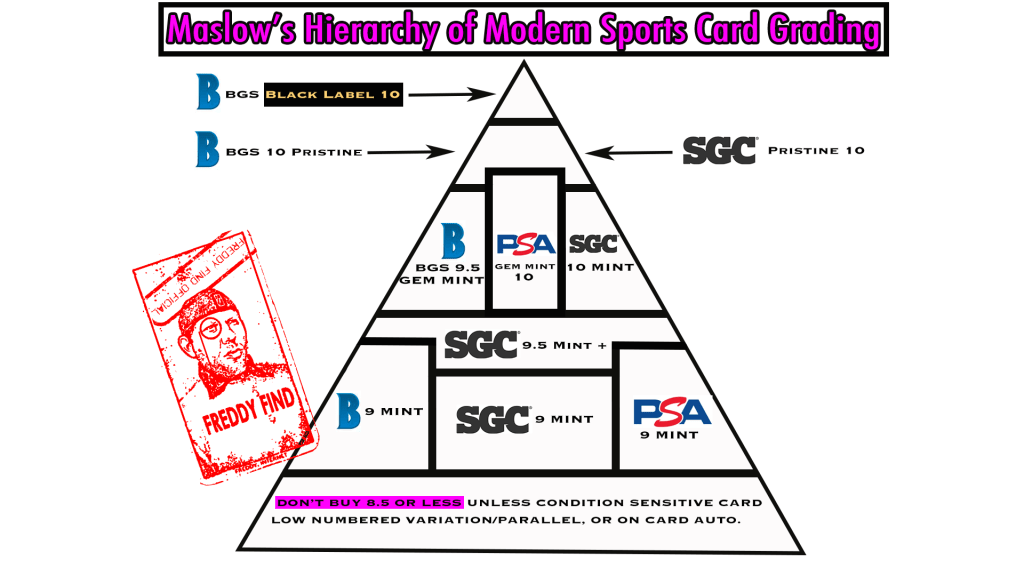
Well… in an effort to democratize and standardize fair pricing among cards graded from the big 3 – BGS, PSA, and SGC —I’ve adapted it and created the MASLOW’S HIERARCHY OF MODERN SPORTS CARD GRADING… a handy dandy reference tool for your sports card investing journey. I’ve broken down the grades from each company into tiers so you can easily compare what a similarly graded card is selling for from each grading company.
Almost forgot. Before we dive in we should go over five general principles and ground rules for our chat:
1. This diagram only applies to graded modern cards from 1981 to today.
2. I’m grading company agnostic as long as a card is graded by PSA, BGS, or SGC. I own cards graded from all 3 companies, and I don’t recommend buying graded cards graded by any other companies.
3. I’m only taking into account the condition of the card. I don’t add any value for the aesthetics of the holder, OCD nature of certain collectors needing all their cards in the same slab, or any set registry components…. if you want to flex your collection just jump on twitter, instagram, youtube, and tik tok like the rest of us… and click on those links so we can be hobby friends.
4. Grading is inherently subjective and riddled with human flaw. There is no objective proof that any of the big 3 are better graders than their competitors. There are plenty of examples with all 3 companies overgrading and undergrading cards. Grading is simply one professional opinion and not a card’s life sentence. Not all PSA 10s are created equal, but neither are all BGS 9.5’s or SGC 10 mints. If you prefer perfect centering, you should probably double check that PSA 10 you have in your eBay cart. But if you’re a corner or edge man or woman, you should definitely take another peek at that BGS 9.5 too.
5. These are generalizations not commandments. Prices can vary greatly tier to tier and within tiers depending on a number of factors including card popularity, scarcity, and condition sensitivity.
Now that that’s out of the way… let’s get back to the pretty diagram!
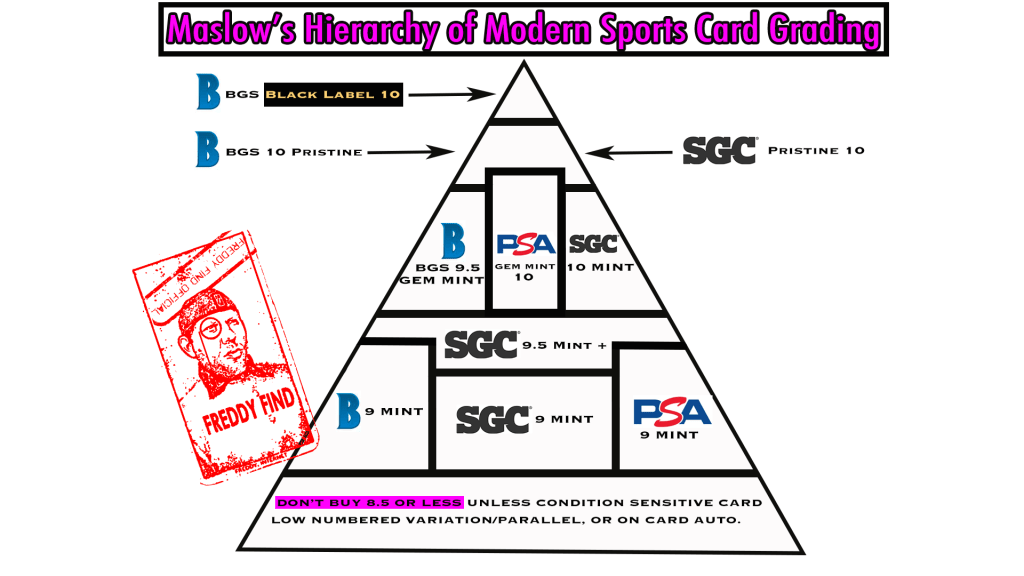
Sitting alone at the top of the graded food chain is the mythical beast, the BGS BLACK LABEL 10. The perfect card. I don’t own any. Wish I did. But these cards are… you guessed it… super duper pricey.

On the next tier we have BGS 10 Pristine, SGC Pristine 10, and the top percentile of PSA Gem Mint 10s. These are almost perfect cards with a slight .5 grade imperfection in either centering, edge, corners, or surface.

The only problem with the top percentile of PSA Gem Mint 10s is that without half grades or a PSA Pristine tier, it can be difficult to ascertain which tier your PSA card falls into. Does it rise to the level of a BGS Pristine 10 or SGC Pristine 10… or sink down to the gem mint level where we find…

… the BGS 9.5, PSA 10, and SGC 10 mint. These are equal grades in most cases… especially if you’re dealing with a bgs 9.5 with quad 9.5 sub grades or better.
Below the gem tier, SGC sits alone with it’s mint + designation. Strong BGS 9 mints… ones with two 9.5 subgrades and two 9.0 sub grades, belong in this category as well…. as do strong PSA 9 mints that are borderline psa 10s. Though it can be difficult again, without the sub grades and half grades, to discern a strong PSA 9 mint from a borderline PSA 9 mint in the slab unless it is a noticeable centering issue or slight corner wear.
Finally, we have the base mint tier.

With modern cards, I don’t recommend buying anything below 9 mint unless it ’s a condition sensitive card like the 1993 SP Jeter, a low numbered variation/parallel, or an on card auto.

The purpose of MASLOW’S HIERARCHY OF MODERN SPORTS CARD GRADING is to put each major grading company’s grades into equal tiers for fair and equitable valuation when you’re making a buying decision.
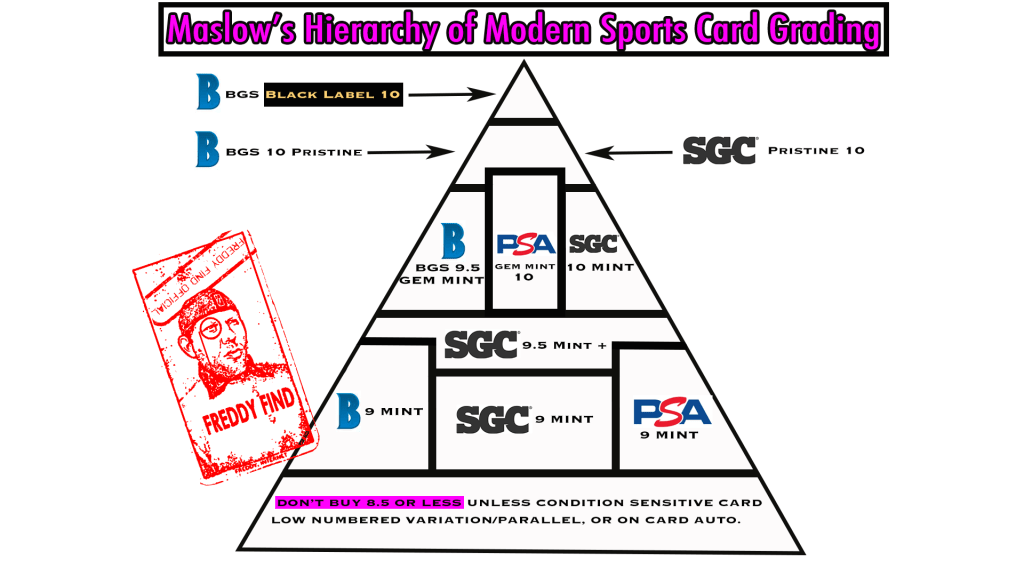
Next time you’re looking for deals for a certain card just whip out this handy dandy guide to aid your buying decision. Hopefully the cards in each tier will be priced similarly soon… and if they’re not, buy a whole mess of gem mint grade BGS 9.5s (all 9.5 subgrades or higher), cross them over to PSA 10’s, and make a boatload of money.
If you prefer watching instead of reading your content, be sure to click here to watch this episode on the Freddy Find YouTube channel or right here to watch on the website.
As always, I’m Freddy… and you’re welcome.
Leave a Reply